Better Water Starts With Knowing What’s Actually in It

Water is one of those things most people don’t think much about until something seems off. Maybe there’s a strange taste in the morning coffee, white buildup around the faucet, a sulfur-like smell, or spots left behind after washing dishes. Sometimes the issue is obvious. Other times, the water looks perfectly clear but still contains minerals or other substances that affect how it tastes, feels, or behaves around the house.
That’s why choosing a treatment system shouldn’t begin with a product brochure. It should begin with the water itself.
A good treatment approach considers the source, the contaminants present, the amount of water a household uses, and what the homeowner actually wants to accomplish. There isn’t one magic system that solves every water problem. And honestly, that’s a good thing.
Start With the Water Source
The first question is surprisingly simple: where does your water come from?
Homes connected to a municipal supply and homes using private wells can face very different water-quality concerns. City water is generally treated before it reaches the property, but that doesn’t mean every household experiences the same taste, odor, hardness, or plumbing-related issues. Water can also pick up characteristics as it travels through distribution systems and household plumbing.
Private wells have their own considerations. Groundwater naturally moves through soil and rock, picking up minerals and, depending on local conditions, other substances along the way. A well may provide excellent water, but testing is especially important because there isn’t a municipal treatment plant managing the supply.
This is where well & city water treatment becomes more than a general service phrase. The right approach depends on the source and the specific characteristics of that water.
Testing Should Come Before Treatment
It’s tempting to see a problem and immediately buy a filter. But treating water without knowing what you’re treating can be a bit like taking medicine without knowing what’s wrong.
A basic water analysis can reveal important information about hardness, pH, iron, manganese, dissolved solids, and other characteristics. Depending on the water source and local concerns, additional testing may be appropriate.
Testing also helps prevent unnecessary treatment. If hardness is the primary issue, for example, there may be little reason to install equipment designed for a completely different contaminant.
The goal isn’t to create the most complicated setup possible. It’s to create the right setup.
Hard Water Is More Than an Annoyance
Hard water is common in many areas, and the symptoms are familiar: chalky deposits on faucets, dull-looking glassware, dry-feeling skin, and mineral buildup inside appliances.
Over time, those minerals can create headaches for plumbing and water-using equipment. Water heaters, dishwashers, washing machines, coffee makers, and other appliances can all be affected by mineral accumulation.
For households dealing primarily with hardness, water softeners can be a practical part of a broader water-treatment strategy. They work differently from drinking-water filters, so it’s important to understand what a softener is designed to do rather than expecting it to remove every possible contaminant.
There’s also the everyday comfort factor. People often notice softer water when soap lathers more easily or when that stubborn white film around the shower finally starts disappearing.
Drinking Water Deserves Its Own Attention
Whole-home treatment and drinking-water treatment don’t necessarily have to be the same thing.
Some homeowners want treated water throughout the house because of hardness, iron, sediment, or odor. Others are mainly concerned with what comes from the kitchen tap. In those cases, point-of-use treatment can make more sense.
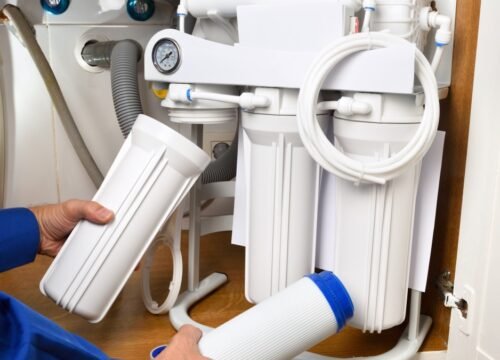
Reverse osmosis drinking water systems are one option for producing highly treated water at a dedicated faucet. Reverse osmosis uses a semipermeable membrane to reduce many dissolved substances, although the exact performance depends on the system, membrane, incoming water quality, and maintenance.
genui{“learning_viz”:{“type_id”:”OSMOSIS”}}
This kind of system can be particularly appealing to people who prefer the taste of purified water for drinking and cooking. It can also reduce reliance on bottled water, which is a small but meaningful change for households trying to cut down on plastic waste.
Sediment Shouldn’t Be Ignored
Sometimes the problem isn’t something dissolved in the water at all.
Sediment can enter water supplies and may appear as cloudiness, grit, or visible particles. Older plumbing, well conditions, construction activity, and other factors can contribute to sediment problems.
A sediment filter is often used as an early stage of treatment because it can capture physical particles before water reaches more specialized equipment. That’s useful for protecting downstream components, too.
Think of it as giving the rest of the system less dirty work to do.
Odor and Taste Can Tell a Story
Water that smells like rotten eggs, tastes metallic, or has an unusual chemical flavor shouldn’t simply be dismissed as “normal.”
Different odors can have different causes. Hydrogen sulfide is one common reason for a rotten-egg smell, while iron can contribute to metallic tastes and staining. Chlorine-related taste and odor can also be noticeable in treated municipal water.
The important thing is not to assume that every unpleasant smell needs the same filter. Treatment should be selected based on testing and diagnosis.
That’s one reason professional evaluation can save homeowners money in the long run. Installing equipment that doesn’t match the actual problem doesn’t solve much.
Think About the Whole House
A common mistake is focusing only on drinking water while ignoring everything else the household uses water for.
Showers, laundry, bathing, dishwashing, cooking, and appliances all interact with the water supply. If hardness is causing scale throughout the house, a kitchen filter alone won’t address the underlying issue.
On the other hand, if the main concern is drinking and cooking, treating every gallon entering the home may be unnecessary.
A well-designed system considers where treatment is needed and where it isn’t. That balance matters because more equipment isn’t automatically better.
Maintenance Is Part of the Deal
Even excellent treatment equipment needs attention.
Filters eventually become loaded with sediment and contaminants. Membranes need replacement according to manufacturer recommendations. Softener systems require appropriate salt management and periodic checks. Connections, settings, and other components should also be inspected when necessary.
Skipping maintenance can reduce performance and, in some cases, create new problems.
It’s easy to forget about a treatment system because it sits quietly in a basement, garage, utility room, or under the kitchen sink. Out of sight, out of mind. But a simple maintenance schedule can keep the equipment doing what it was installed to do.
Choosing a System Without Overcomplicating It
The best water-treatment setup isn’t necessarily the biggest or most expensive one. It’s the one that addresses the actual water-quality concerns of the property.
Start with testing. Identify the source. Separate whole-home concerns from drinking-water concerns. Consider household size and water consumption. Then look at equipment that fits those needs.
A professional installer can also help determine whether multiple treatment stages are necessary and how they should work together.
In the end, better water isn’t really about owning more equipment. It’s about understanding your water and making thoughtful choices based on that information. Once you know what’s coming through the tap, the path forward becomes much clearer—and usually a lot less complicated than it first seemed.